
Product
Sieve (Smart Inspection of Every Value Exchange) gives fintechs, wallets and banks a fraud decision on every event. One API call returns allow, review or block in milliseconds, with the reasons attached.
Around that decision sit the tools a fraud team needs: rules they can read, a memory of fraudsters who come back, sanctions and PEP screening, an AI investigator that writes the case file, and a scanner that finds holes in payment code before a fraudster does.
The problem
Fraud moves in seconds. Most teams find it days later.
It happens every week: money splits across dozens of wallets in seconds, is cashed out through agents, banks and crypto within minutes, and the team reads the report days later, when nothing can be recovered.
- Built for cards. Most tools come from the US and Europe, not for mobile money or USSD, and miss SIM-swap drains, account takeovers and mule networks.
- Too costly, too slow. Big licences and months of setup, so small fintechs go without.
- Stricter rules. AML rules are tightening in Nigeria, Kenya and beyond.
Why now
Africa now pays instantly, and fraud follows the money: 64 billion instant payments worth $1.98 trillion in 2024, and 347 million active mobile money accounts, about 60% of the world's.
Who it's for
- Fraud and risk teams at fintechs, mobile-money wallets, payment companies and banks in Kenya and Nigeria.
- Developers who need one API key, a clear response and to be live in minutes.
- Compliance officers who need evidence: an audit log, seven-year records and controls a risk committee can sign off.
My role
I work on product at Sieve, alongside an engineering team split between Lagos and Nairobi.
- Built the real-time fraud detection MVP: fraud-scoring rules, SIM-swap risk signals, AML checks and transaction monitoring workflows.
- Took it into a live pilot with Lipana, where it has checked 325 payments and stopped 13 fraud attempts at 95% accuracy.
- Built the early go-to-market: fraud-prevention guides, outreach playbooks and a scored prospect pipeline mapping 1,300+ licensed lenders, PSPs, banks and SACCOs across Kenya and Nigeria.
How it works
Rules decide fast. AI does the slow work.
- Connect. Send each payment, login or payout to the API.
- Enrich. Add device, SIM, location and sanctions data.
- Decide. Rules and a machine-learning score answer allow, review or block, and say why.
- Investigate. AI summarises the case and suggests the next step.
- Report. AI drafts the report for the regulator. A person checks and sends it.
Every decision is kept for seven years in an audit log that shows if anyone changes a record.
What we built
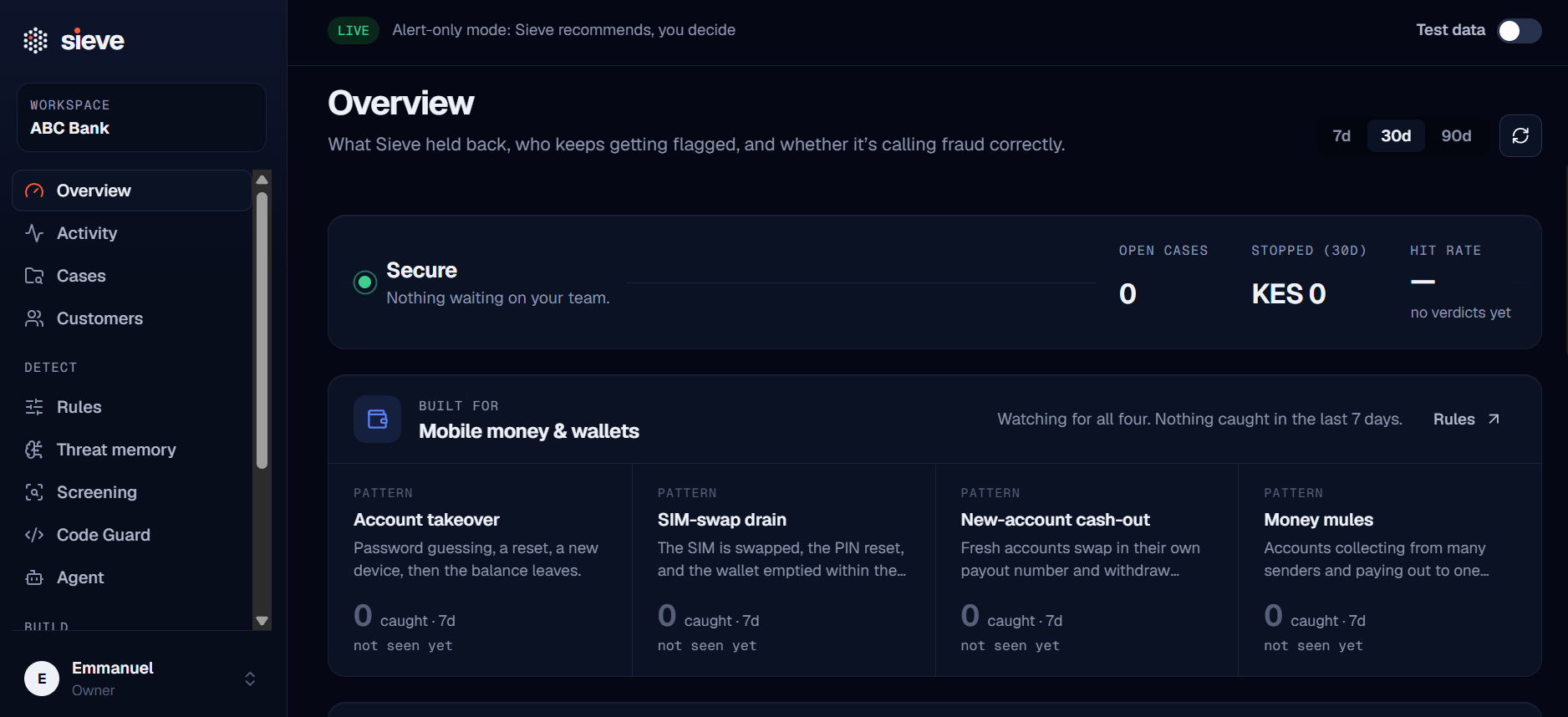
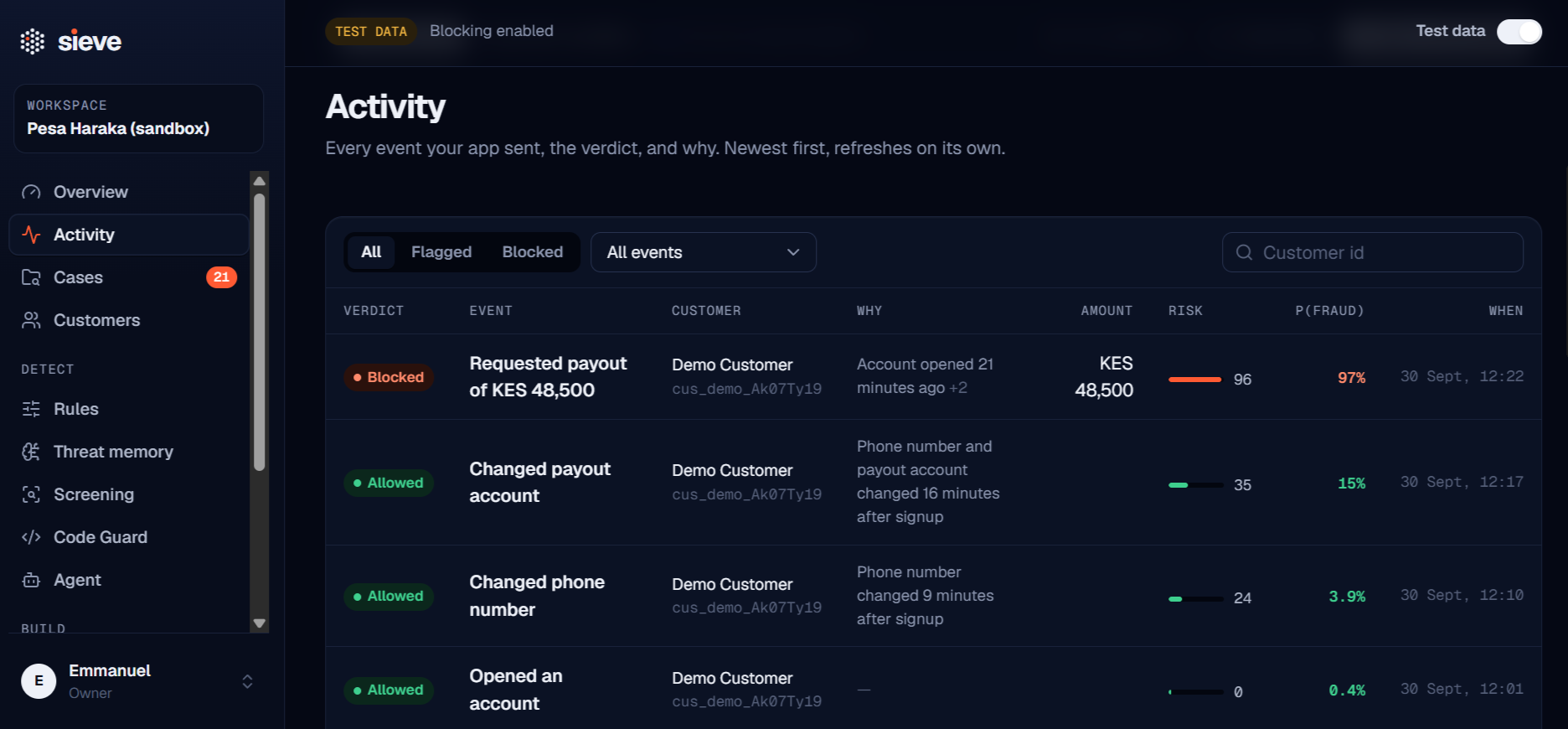
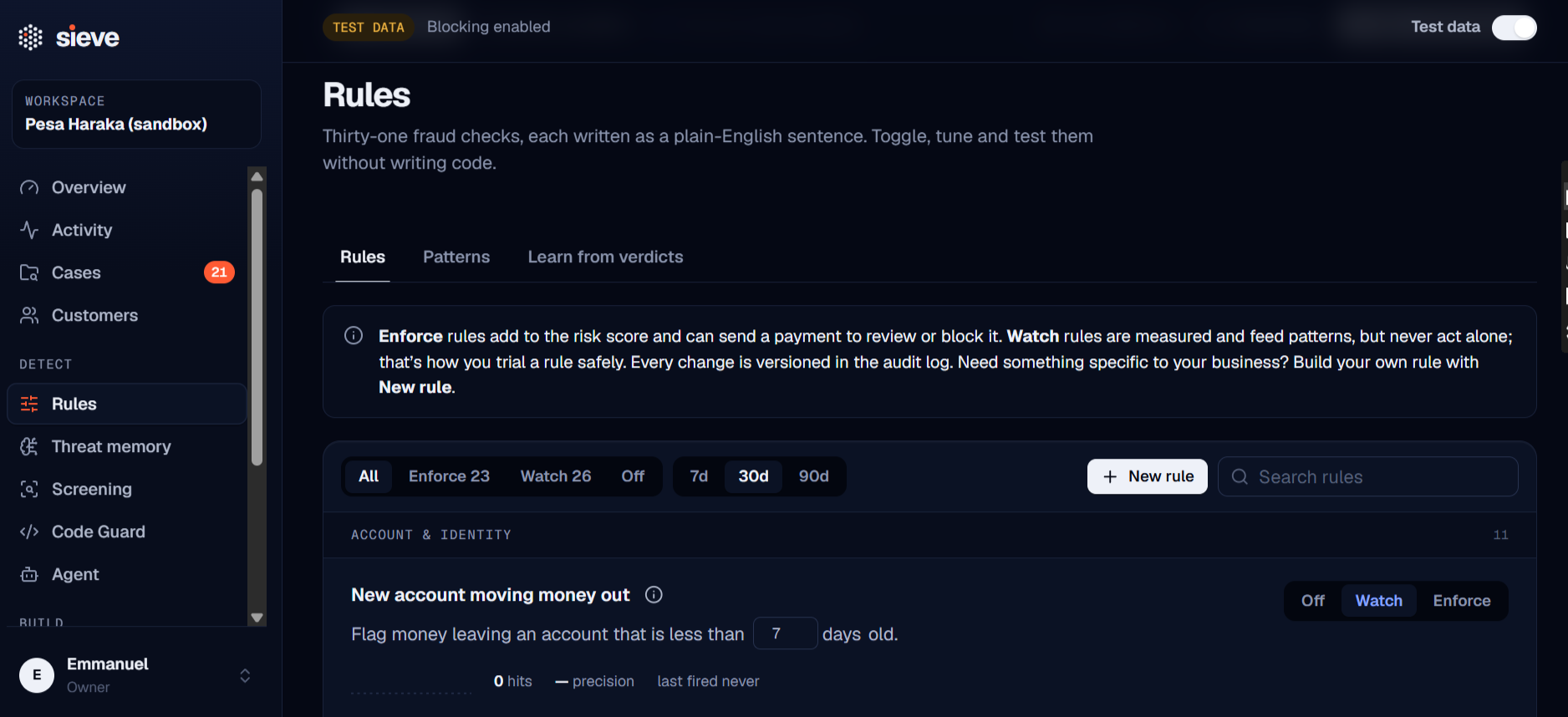
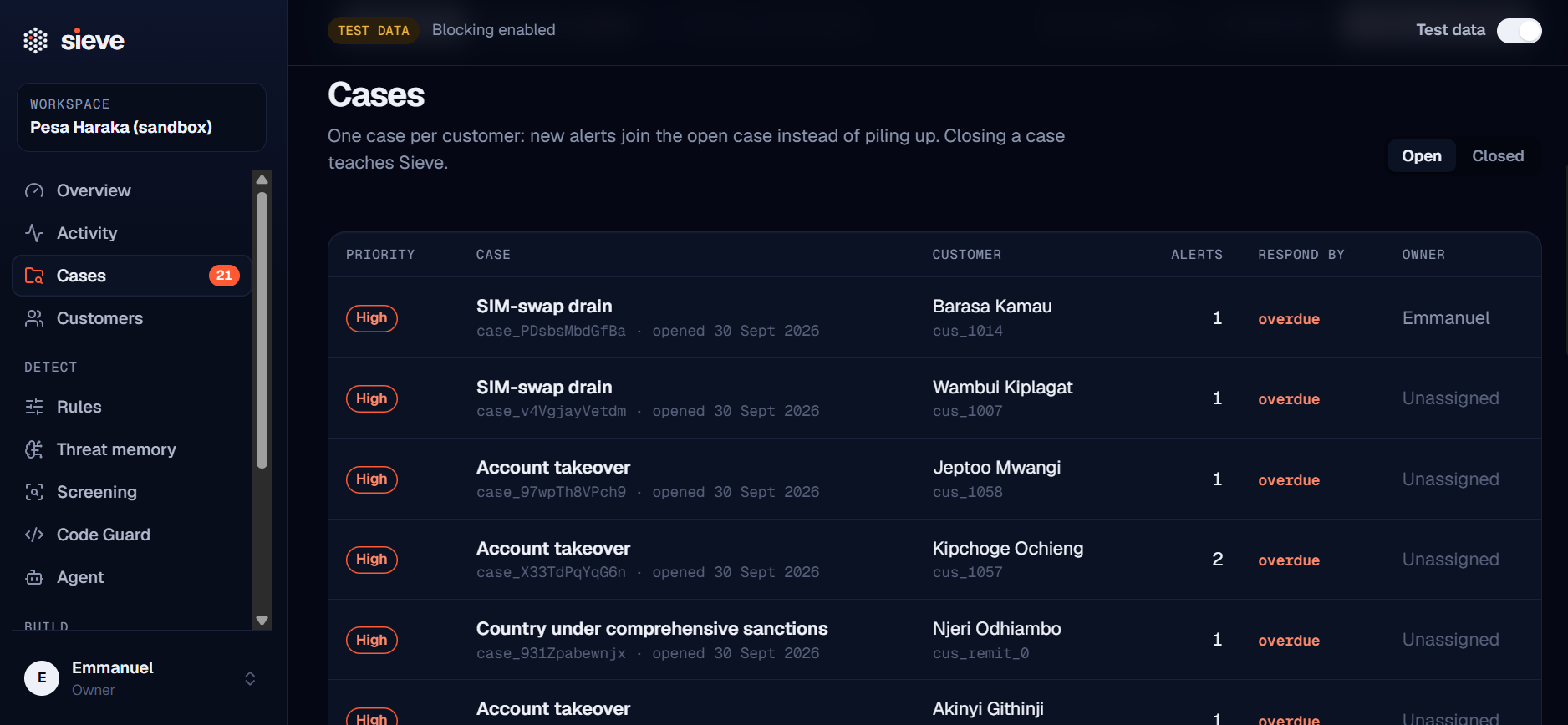
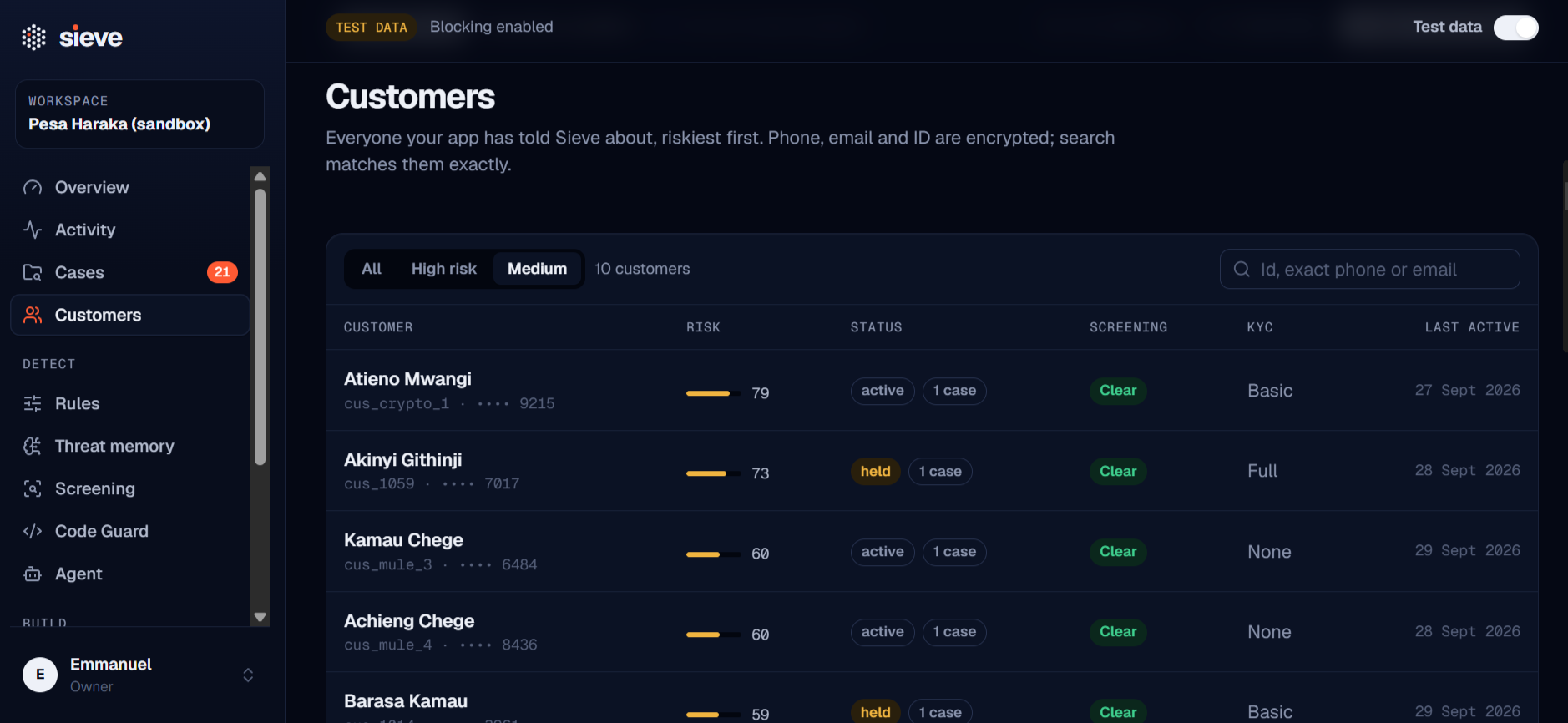
Screenshots are from sandbox workspaces with test data.
Key decisions
Explain everything
Every verdict carries its reasons, and every rule is a sentence. If a fraud analyst can't explain a block to a customer or a regulator, the product hasn't done its job.
Watch before you enforce
New rules can run in Watch mode: measured and fed into patterns, but never acting alone. Teams trial a rule on live traffic safely, then switch it on.
AI earns its place
The AI investigator recommends and drafts; people decide. It can run on Claude or on a model the customer hosts, so data never has to leave the building.
Pay for what you use, no big licence
$0.01 per check and $0.10 per monitored customer a month, with 10,000 free sandbox events, so a two-person fintech can start the same day as a bank.
Run where the customer needs it
Banks can run Sieve in our cloud or on their own servers, with local rules and lists (CBN, CBK) built in.
Traction
Sieve is live with Lipana, a Kenyan M-Pesa payments company, checking real payments.
On our benchmark
Key takeaways
- In risk products, trust comes from being able to explain the answer, not from the score alone.
- Letting customers try a rule safely made it far easier for them to say yes to switching it on.
- Building for local fraud patterns first beat trying to be a global tool on day one.